
Your Community May Have a Disaster Blind Spot. Foresight is Built to Find It.
The Gap Between What Has Happened and What Could
Are the communities you serve prepared for what could happen — or only for what has happened before?
Highlights
- Disaster preparedness systems built on historical records have a blind spot — and it is growing. Extreme events are intensifying faster than communities can accumulate experience with them, which means the gap between what disaster managers have planned for and what is now possible has been silently widening.
- Foresight in Disaster Management is a NASA Disasters Program project building a science-based foundation for planning beyond the historical record. Led by Tufts University, Foresight identifies plausible extreme events that communities haven’t experienced yet — but that today’s conditions can credibly produce.
- The project is building a new dynamic scenario planning tool to put that science foundation directly into the hands of disaster managers and planning teams. This Scenario Library will give practitioners the ability to use NASA and other trusted data to simulate extreme events and stress-test their preparedness strategies against realistic potential future scenarios that historical records alone may obscure.
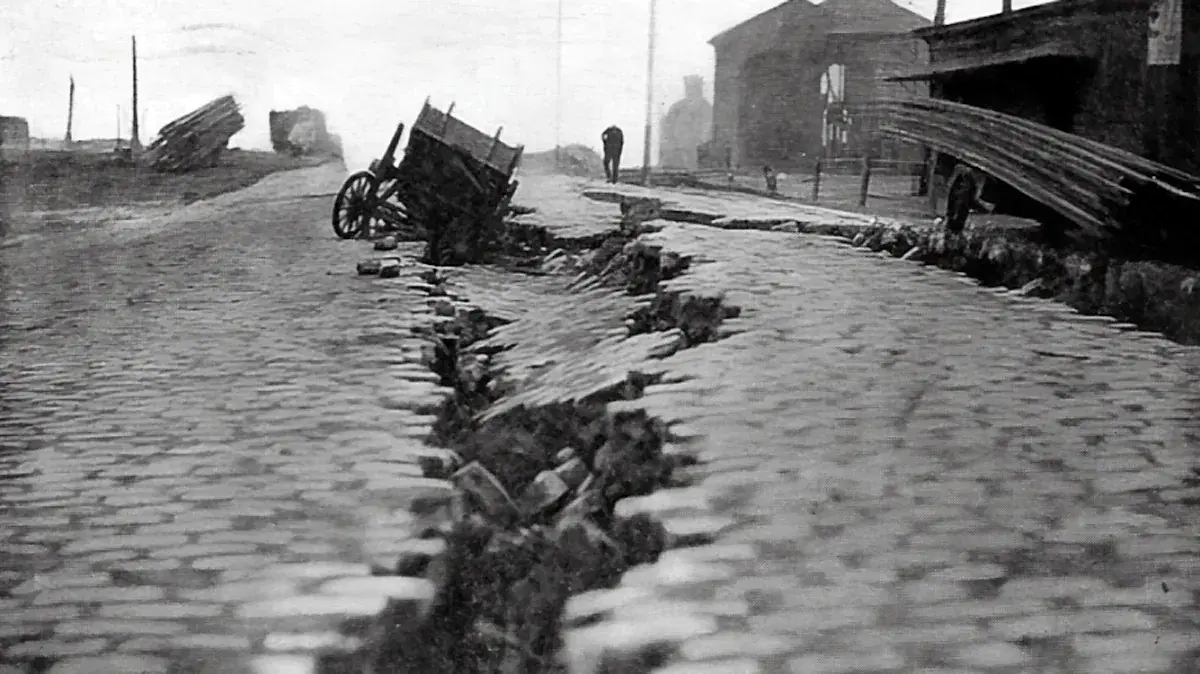
For most disaster managers, contingency planning starts with history: the storms, floods, and heat events that shaped a region’s experience and informed its preparedness systems. That foundation has served the field for a long time, but in a changing Earth system environment, it is no longer enough. Extreme events are intensifying faster than communities can gain experience with them. In many places, the frequency and intensity of hazards have been climbing gradually — not through obvious landmark disasters that demand attention, but year by year, in ways that don’t register until something arrives that the plan wasn’t built for.
“Disaster planning based on historical events is like driving forward while only looking in the rearview mirror,” says Erin Coughlan de Perez, Associate Professor at Tufts University Friedman School of Nutrition Science and Policy and principal investigator on the project. “Many communities are planning for what they have seen in the past, only slightly worse. They need to be preparing for things they haven’t seen at all.”
Foresight in Disaster Management is a NASA Disasters Program Science-to-Action (DS2A) project working to close that gap. Led by the team at Tufts and working in collaboration with Spelman College, Oregon State University, the American Red Cross, and UNHCR (the Office of the United Nations High Commissioner for Refugees), Foresight is building a science-based foundation for anticipating extreme events that have no precedent in a community’s local history — but that today’s climate has made entirely plausible.
Seeing Past the Historical Horizon
Foresight pursues that goal through three interconnected aims.
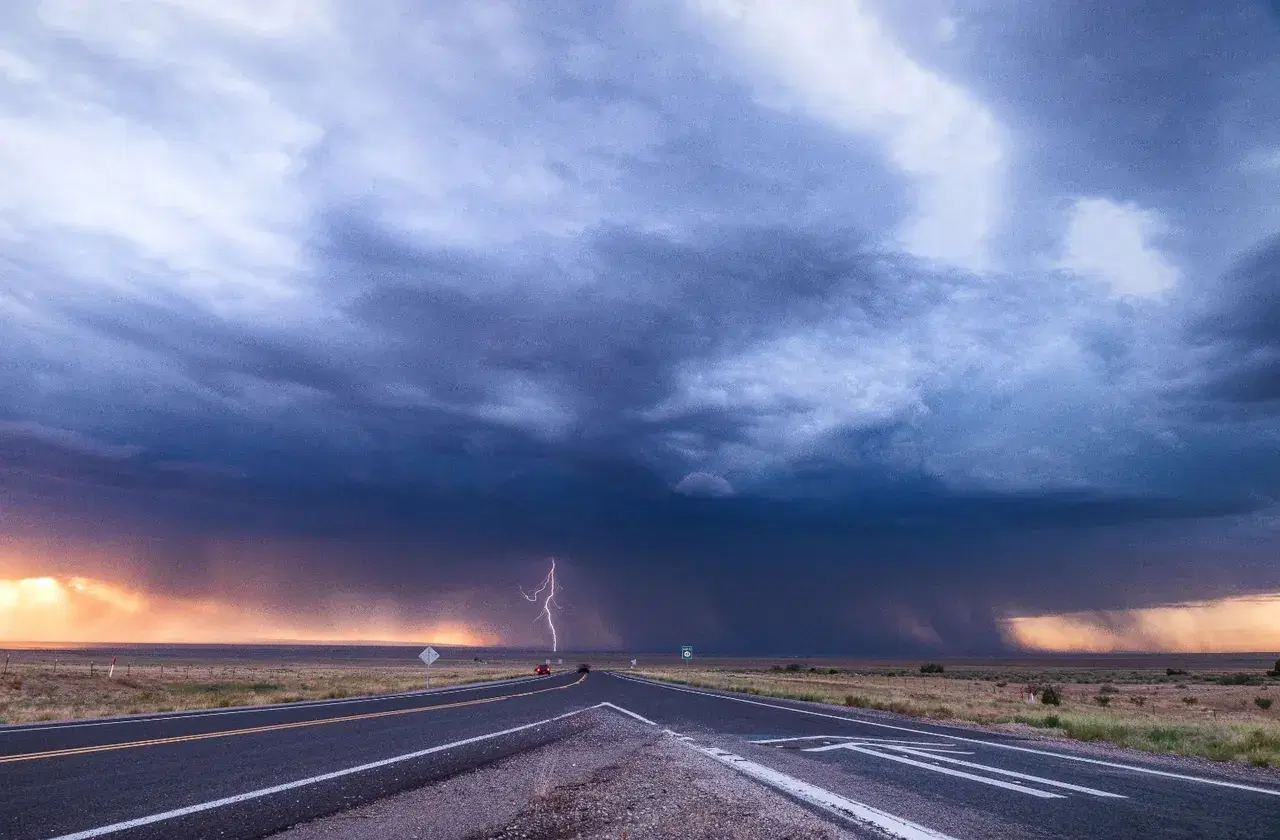
The first is to map the space of what is actually possible. Using NASA Earth observation data alongside large ensemble climate and weather models, the team applies the UNSEEN (UNprecedented Simulated Extremes using Ensemble) approach to generate distributions of extreme events that are consistent with today’s climate conditions but absent from the historical record. The outputs are not forecasts. They are plausible scenarios: events that are physically consistent with what the science says the climate of a specific location can actually produce. Plausible, here, is a precise term: a scenario developed for a community reflects what the hazard environment of that region genuinely supports, such as an unprecedented heatwave in Florida. Scenarios that would defy the physical realities of the models, such as a hurricane in Idaho, are not generated.
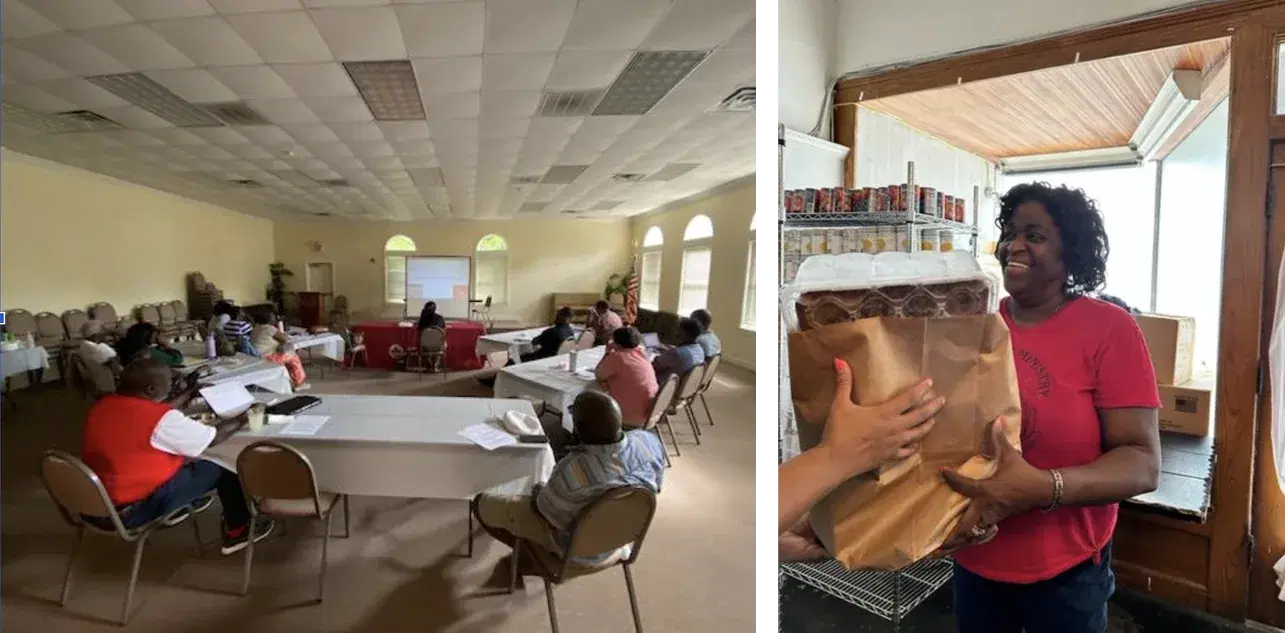
The second aim is harder to quantify but just as important: how prepared are communities actually? Through interviews, focus groups, and document analysis, the Foresight team assesses community capacities, and documents what could go wrong. Some communities carry recent experience with severe events and maintain active preparedness. Others have seen disaster risk rise but have not recently experienced the kind of dramatic event that prompts updated planning. These communities face what the team calls a “high potential for surprise,” that is, places where the most extreme event in living memory may no longer reflect how risky conditions have become. As Coughlan de Perez describes it, for communities across the southeastern United States: “It’s a roll of the die whether they have experienced a really extreme event or not.”
The third aim turns that analysis into something practitioners can effectively use. Working with disaster management stakeholders, the team co-develops event-based storylines of extreme events — detailed, plausible narratives grounded in UNSEEN outputs — for use in scenario planning exercises. The storylines give practitioners something specific to plan against: a realistic account of what a severe event could look like in their community, under current conditions, and what it would ask of their systems and their partners. Disaster managers give feedback on results throughout and help shape the final products. The science is being built with the people who will use it.
From Simulation to Preparation
That working relationship with practitioners in their communities is now shaping one of the project’s most practical developments.
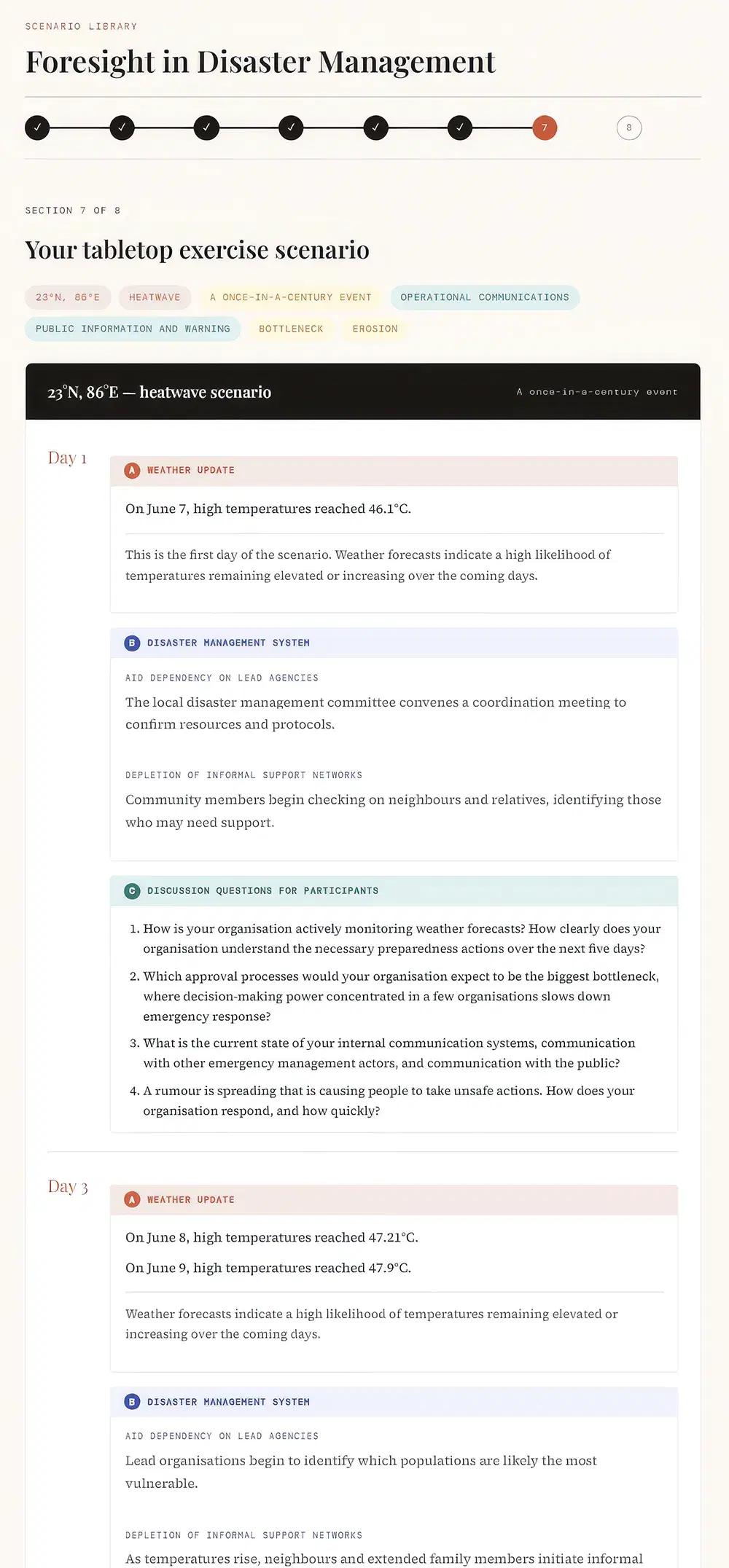
The Scenario Library is a dynamic scenario planning platform being built by the team in collaboration with the American Red Cross, UNHCR, and the Massachusetts Office of Climate Science. The new tool will fuse NASA Earth observation data with climate science, geospatial analysis, and social systems analysis — giving disaster managers the ability to run simulations of plausible extreme events and stress-test their preparedness strategies against conditions that no historical dataset can supply.
The practical range of what that enables is worth contemplating for a moment. A disaster manager could explore whether existing cooling shelter contracts are sized for a heatwave that outlasts anything on record. A planner making long-range infrastructure decisions could examine how current hazard probabilities should shape where new facilities are built and to what standard. An anticipatory action team could use scenario outputs to set new response thresholds for events with no local precedent — so that when conditions exceed anything the community has seen before, the response is already mapped out. For communities that may be already stretched thin on preparedness, the gap between having a plan and not having one shows up in very real ways — like whether cooling centers open in time, whether evacuation routes are mapped before they are needed, or whether the people most at risk have somewhere to go.
Cornerstones
- If your community hasn’t faced a severe event recently, that may be cause for concern, not comfort. Communities where recent history has been quiet are often the ones who haven’t updated their plans. The absence of a recent disaster does not mean that risk has disappeared.
- Scenarios are planning tools, not forecasts — use them accordingly. Foresight’s outputs describe what is plausible given current conditions in a specific location, not what is predicted to happen in the coming days or months. The right question to bring to them is not “will this happen?” but “are we ready if it does?”
- Policies addressing extreme heat and flooding remain limited in many parts of the United States. The science for anticipating these events is advancing faster than the policy frameworks designed to act on it, and there are major policy gaps for preparedness for extreme heat across the country.
- Early awareness of tools in development is an advantage worth acting on. The Foresight Tool is still being built. Practitioners who engage now — understanding what it is designed to do and how it fits into existing preparedness workflows — will be better positioned to use it effectively when it becomes available.
“Our ultimate goal,” Coughlan de Perez says, “is to provide a framework to help all communities prepare for weather events they may not have experienced before but have a high likelihood of facing in the future.”
There’s something almost counterintuitive about what Foresight is trying to do. Its most consequential work isn’t done in the aftermath of a disaster — it’s done in those places where calm has come to feel normal, before anything has arrived to disturb it. The Foresight Tool is being built for those communities. Where plans can still be written before they are needed.
Explore the Foresight Tool
Connect and Learn More
Would you like to help test or provide feedback on the new Foresight dynamic scenario planning tool or Scenario Library as they are still being developed? Email the developers.
About the PI: The Foresight project is led by Erin Coughlan de Perez at Tufts University.